
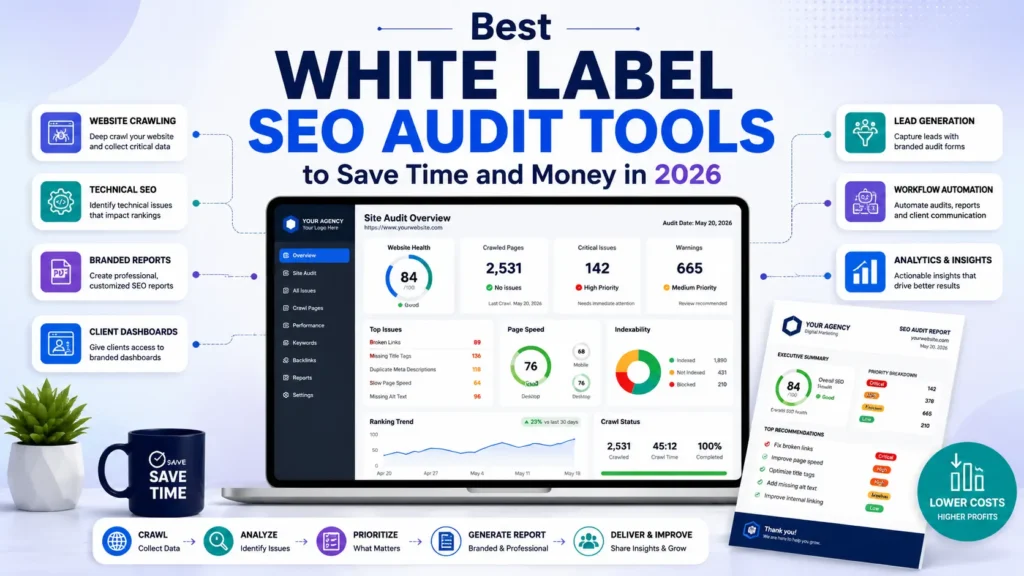
An agency can spend hours crawling a client site, copying issues into a document, applying brand formatting, rewriting generic recommendations, and preparing a presentation that still leaves the client asking what needs attention first. The work becomes harder across ten, twenty, or fifty accounts. A white label SEO audit tool can remove much of the repetitive collection and presentation work, yet the wrong platform creates a different problem: shallow checks, weak explanations, unexpected usage fees, exposed vendor branding, and reports that require extensive rewriting.
The strongest tool is not always the platform with the largest feature list. An audit used for prospecting needs fast scanning, attractive branding, and lead capture. A paid technical engagement needs deeper crawling, evidence at URL level, exportable data, prioritization, and a reliable review process. An ongoing SEO program also needs scheduled monitoring, client access, historical comparisons, and integration with first-party performance data.
This article compares the best white label SEO audit tools for agencies in 2026, explains where each option fits, and presents a practical method for testing audit quality before committing to a subscription. It also covers real operating costs, report design, client portals, lead-generation audits, implementation, and the limits of automated analysis.
A white label SEO audit tool scans a website, identifies optimization issues, and presents the output under an agency’s identity. True white labeling extends beyond placing a logo on a PDF. The platform may also support branded colors, custom report text, agency contact details, a custom sending address, a branded subdomain, client logins, scheduled delivery, and removal of the software vendor’s name. The required level depends on how the agency sells and delivers the audit.
Audit functionality also needs a clear boundary. A crawler can identify broken links, status codes, missing metadata, duplicate elements, internal-link patterns, performance signals, structured data, indexability directives, and many on-page conditions. Google’s documentation confirms that crawling, indexing, robots controls, canonicalization, sitemaps, page experience, and structured data are distinct technical areas, so a useful audit needs more than a single health score.
Software does not replace professional judgment. A report can flag a title tag as long, yet it cannot fully judge commercial relevance, message quality, brand accuracy, or the value of the page. It may flag blocked URLs without understanding that the block is deliberate. Agencies need a platform that speeds up evidence collection and reporting, then leaves room for an analyst to validate the issue, explain its impact, and set a sensible priority.
The tools in this article were assessed through seven agency requirements: audit coverage, evidence quality, branding control, client delivery, workflow automation, scalability, and cost structure. Audit coverage refers to the range of technical, on-page, performance, content, and visibility checks. Evidence quality refers to the platform’s ability to identify affected URLs, explain the issue, and support verification. A polished score without traceable evidence has limited value in a paid audit.
Branding control covers PDFs, email delivery, domains, portals, interface elements, and vendor references. Client delivery covers shareable reports, read-only access, scheduled updates, and the ability to add agency commentary. Workflow automation covers templates, repeated scans, bulk projects, integrations, exports, APIs, and report scheduling. Scalability covers project limits, user seats, crawl allowances, speed, and account organization.
Cost was assessed as an operating model, not a headline subscription price. Agencies also need to consider add-ons, crawl credits, rank-tracking limits, extra projects, report limits, API access, user seats, setup time, analyst review, revisions, and client support. Vendor prices and packaging can change, so the final purchasing decision needs a current quote and a test account using representative client data.
No single platform leads every category. The strongest option depends on the audit’s purpose, the number of client accounts, the required branding depth, the technical complexity of the sites, and the amount of human analysis added before delivery. The following tools represent distinct agency use cases instead of interchangeable versions of the same product.
SEOptimer is a strong fit for agencies that need rapid website reviews, configurable white label PDFs, and an embedded audit form for lead generation. Its official product pages state that the platform runs more than 100 checks and supports branded reporting plus website embedding. The current white label plan is positioned as a lower-cost option for marketers, which makes the tool accessible for agencies selling entry-level audits or using website reviews inside a sales process.
The main strength is speed from domain entry to presentable output. That same strength defines the limitation. Fast review tools work well for prospect qualification, account snapshots, and standardized small-business audits. Complex ecommerce sites, JavaScript-heavy platforms, international setups, large publishing systems, and migration diagnostics still require deeper crawling and manual validation. SEOptimer works best when the agency treats the generated report as a starting point, removes low-value items, adds business context, and converts the strongest issues into a prioritized action plan.
SE Ranking suits agencies that want website auditing, rank tracking, competitive analysis, reporting, and client access inside one branded environment. Its official white label documentation supports a custom domain, customized interface, branded login experience, controlled footer elements, and reports sent through the agency’s own email setup. The Agency Pack also includes white label reporting and lead-generation features, creating a broader agency operating system around the audit.
This platform fits recurring retainers more naturally than one-off audit production. A team can establish a baseline, monitor website health, track rankings, connect reporting, and give selected clients controlled access. The tradeoff is package complexity. The agency needs to model the base plan, Agency Pack, project limits, tracked keywords, crawl allowances, user needs, and optional AI visibility features. SE Ranking becomes more valuable when several included tools replace separate subscriptions. Agencies needing only occasional branded PDFs may carry more platform than the workflow requires.
WebCEO is designed around agency resale, branded reporting, custom-domain access, and multi-client SEO management. The platform supports live white label audit reports on an agency subdomain, read-only client access, and limited public access that can turn audit tools into a lead-generation asset. WebCEO also presents its broader toolset as private-label software that agencies can operate under their own brand.
The strongest use case is an agency that wants clients or prospects to interact with branded software, not only receive a static report. This model can support retainers, reseller programs, and packaged access to an SEO dashboard. The commercial limitation comes from variable usage charges and account structure. Project fees, scan usage, rank queries, backlinks, and related activity can affect the real cost. A detailed quote at current volume and projected volume gives a more accurate answer than the base subscription alone. The interface also needs testing with account managers and clients before a broad rollout.
Sitechecker is most useful for agencies that view an audit as a recurring monitoring system. Its white label platform combines Site Audit, Google Analytics, Google Search Console, and Rank Tracker data across many websites. The product emphasis is ongoing campaign visibility, issue monitoring, proof of completed work, and client communication through branded reporting.
This orientation helps teams manage website health after the initial assessment. A monthly retainer needs more than a launch document; it needs issue history, alerts, progress records, and a clear view of new problems. Sitechecker supports that continuous model. Agencies should still assess crawl depth, JavaScript handling, custom extraction, log-file needs, and enterprise-scale controls against their client portfolio. It can serve as the main monitoring layer for standard client sites, then work beside a specialist crawler for complex technical investigations.
WooRank focuses strongly on agency sales enablement. Official product pages describe unlimited website reviews on sales plans, customizable white label PDF reports, embedded lead-generation tools, technical website audits, and bulk reporting for prospect analysis. This combination supports agencies that use audits to open sales conversations, qualify opportunities, and prepare branded diagnostic material before a proposal.
The platform works best when business development teams need consistency and speed across many domains. A sales audit should identify credible problems without pretending to replace a full engagement. WooRank’s output still needs review before presentation because automated scores can encourage teams to overstate minor issues. Account executives also need guidance on how to explain findings accurately. Agencies with advanced technical SEO retainers may use WooRank at the front of the funnel and a deeper crawler during delivery.
Semrush combines Site Audit with keyword research, competitor analysis, backlink data, rank tracking, AI visibility features, and automated white label reporting. Official documentation states that agencies can build reports from Semrush and connected sources, apply white label branding, schedule delivery, and use client portal options. Its current Site Audit also includes checks related to AI crawler access, adding another diagnostic layer for brands monitoring visibility across traditional and generative search experiences.
Semrush is strongest when the audit needs strategic context beyond technical errors. The analyst can connect crawl findings with keyword gaps, competitive pages, backlinks, ranking movement, and AI visibility data. The limitation is cost and complexity. Teams pay for a broad research suite, and white label functions may involve plan or reporting requirements. Semrush fits established agencies that use the data across research, strategy, pitching, and ongoing delivery. A small team needing simple branded audits can gain more value from a narrower platform.
MetricSpot is an audit-first platform built around branded PDFs, scheduled rescans, multilingual reports, and a straightforward agency price structure. Its official pages state that the tool runs more than 90 checks, removes MetricSpot branding on paid white label reports, supports a custom brand kit, and offers unlimited domains and scheduled audits on its Pro plan. Current public pricing lists a free tier, a Starter plan at $29 per month, and a Pro plan at $49 per month.
The value proposition is clear for freelancers and smaller agencies that need presentable reports without a large platform commitment. The limitation is maturity and ecosystem depth compared with long-established suites. Buyers should test data consistency, crawl behavior, support quality, export options, uptime, and roadmap stability. MetricSpot can reduce software cost for standardized audits, yet larger agencies may still need separate tools for deeper backlink analysis, enterprise crawling, campaign reporting, and advanced permission management.
A freelancer or small agency selling one-off audits usually benefits from SEOptimer or MetricSpot. Both reduce report production cost and keep the workflow focused. SEOptimer has a stronger lead-generation orientation, and MetricSpot presents a lower-cost scheduled audit model. The better fit comes from the desired sales process, required check coverage, branding controls, and confidence in the vendor’s support.
A growing SEO agency managing recurring campaigns gains more from SE Ranking or Sitechecker. SE Ranking provides a broader toolkit and client-facing environment. Sitechecker emphasizes ongoing monitoring and clear website health management. Agencies offering white label SEO also need to separate software from fulfillment. Software collects and presents data. Qualified people still validate the audit, create the roadmap, implement changes, and communicate the commercial meaning.
A reseller program or software-style offer points toward WebCEO because client access and branded platform delivery form part of the product design. A sales-heavy agency may prefer WooRank for prospect reviews and bulk reporting. An established strategy team using audits alongside competitive research, content analysis, links, rankings, and AI visibility can justify Semrush. Agencies serving location-based companies may also connect the audit process with a dedicated white label local SEO workflow for profiles, citations, reviews, and location pages.
A dependable audit system has five layers: coverage, evidence, priority, presentation, and operations. Coverage defines what the software checks. Evidence identifies the affected URLs, source data, and reason for the flag. Priority converts technical output into an ordered plan. Presentation communicates the result under the agency’s brand. Operations control templates, scheduling, access, exports, ownership, and repeat delivery. Weakness in one layer reduces the value of the complete audit.
Coverage without evidence produces a score that cannot support implementation. Evidence without priority creates a long issue list that overwhelms the client. Priority without presentation makes the work harder to understand and approve. Presentation without sound analysis turns a polished report into branded noise. Strong operations connect every layer across multiple accounts, analysts, and reporting cycles.
Agencies can use this model during product trials. Review one real report and ask five questions: Did the tool inspect the areas that matter? Can the analyst verify each important issue? Does the report distinguish urgent problems from minor cleanup? Can the agency explain the output clearly under its own identity? Can the team repeat the process at the required account volume? The answers reveal more than a feature comparison page.
Automated audits can confirm many observable website conditions. They can crawl accessible URLs, read response codes, inspect directives, review metadata, detect broken internal links, identify duplicate elements, analyze page templates, test structured data, and collect performance signals. Google also provides first-party reports for indexing, Core Web Vitals, search performance, and individual URL inspection, so agency analysis should combine crawler output with official platform data.
An automated platform cannot reliably determine every business or editorial decision. It cannot confirm that a service page reflects the company’s real offer, that medical or legal statements are accurate, that a product description supports conversion, or that a page deserves consolidation. It may identify a canonical tag but miss the strategic reason behind the canonical structure. It may report a blocked URL as an error even though the block protects faceted navigation from excessive crawling.
The audit therefore needs a human review stage. An experienced analyst validates high-impact findings, removes false positives, groups repeated template issues, connects problems to business outcomes, and assigns ownership. The tool saves time by collecting evidence, but professional value comes from interpretation, sequencing, and implementation guidance. Technical SEO audits support this wider process across crawlability, indexing, site performance, structured data, and site architecture.
A branded report is a document or shareable output carrying the agency’s logo, colors, contact information, and commentary. It works well for proposals, one-time audits, quarterly reviews, executive summaries, and fixed-scope projects. The client receives a controlled snapshot, and the agency decides what information appears. Reports also reduce the training burden because the client does not need to understand a full software interface.
A branded client portal provides ongoing access to live or frequently updated data. It fits recurring retainers, multi-location accounts, in-house collaboration, and clients that expect self-service visibility. Portals need stronger permission controls, custom domains, branded login screens, secure data connections, and clear account ownership. They also create support responsibilities because clients may question every metric or alert they encounter.
Agencies should not pay for portal capability without a client use case. Static reports can support a high-quality service when account managers provide strong interpretation. A portal becomes valuable when it reduces recurring report production, supports transparent collaboration, and gives clients useful access without exposing confusing internal data. The purchasing decision should reflect delivery style, not the prestige of a larger feature set.
A lead-generation audit is a short diagnostic designed to start a qualified sales conversation. It needs speed, simple branding, controlled form fields, reliable email delivery, privacy-aware data handling, and a small set of credible issues. It does not need to reproduce the depth of a paid technical engagement. Tools with embedded forms and instant reports, including SEOptimer, WooRank, and WebCEO, are built around this front-end use case.
The report should avoid exaggerated scoring and fear-based language. A low score can create attention, but the agency still needs to explain the limitations of an automated scan. Strong lead audits identify several visible problems, show their likely business relevance, and offer a professional review as the next step. They should not claim that every warning causes ranking loss or that correcting a checklist guarantees results.
Privacy and sales operations also matter. The agency needs consent language, a documented lead-routing process, ownership of submitted data, and a response standard. A useful audit form connected to a slow follow-up process creates little commercial value. The full workflow runs from submission to qualification, analyst review, personalized outreach, meeting, and scoped proposal.
A controlled trial should use a representative client website, not the agency’s simplest internal site. The test site needs enough complexity to reveal crawl behavior, template duplication, redirects, structured data, performance issues, and reporting limitations. The trial should also include a known list of existing problems so the team can assess what the platform detects, misses, or misclassifies.
This trial measures the actual workflow from scan to delivery. A platform that saves ten minutes during crawling but adds two hours of report cleanup does not improve agency economics.
The real cost includes the subscription, white label add-on, projects, crawl credits, reports, user seats, integrations, API access, rank tracking, storage, setup, analyst review, account management, revisions, and overhead. The pricing model also changes the risk. Flat pricing supports predictable growth. Per-project pricing ties cost to client volume. Credit systems create flexibility but require active monitoring. Enterprise contracts may reduce unit cost and increase commitment.
Software consolidation can create savings. An all-in-one platform may replace separate tools for auditing, rank tracking, reporting, and competitor analysis. That saving only exists when the team uses the included functions well. A low-cost audit tool plus specialized research software may remain more efficient for an agency with a narrow process. The best white label SEO software is the option that reduces total delivery cost without lowering diagnostic quality.
Contract terms deserve the same attention as features. Agencies need clarity on data exports, report access after cancellation, custom-domain removal, client records, API limits, price changes, user permissions, and support response. Vendor lock-in becomes expensive when historical audit data cannot move. Export a sample project during the trial and document the offboarding process before importing every client.
Consider a hypothetical web development agency selling a paid SEO audit to a regional home-services company. The site has 450 indexable pages, several service-area templates, a recent redesign, and inconsistent conversion tracking. The agency uses a branded audit platform for crawling and report production, then assigns a technical specialist to validate findings and an account manager to prepare the presentation.
The software allocation is $149. Additional crawl or reporting usage adds $80. The technical specialist spends 2.5 hours at an internal cost of $55 per hour, producing $137.50 in labor. The account manager spends 1.25 hours at $45 per hour, adding $56.25. A revision reserve contributes $60, and allocated overhead contributes $90. Total delivery cost equals $572.75.
The agency charges $1,100 for the engagement. Gross contribution equals $527.25 after subtracting software, usage, technical labor, management time, revisions, and overhead. This illustration explains a cost structure and does not represent a universal market rate. The audit output includes a branded executive summary, validated issue evidence, prioritized actions, responsible parties, and a ninety-day implementation sequence. The software accelerates collection and formatting, yet human review remains the source of commercial usefulness.
The first failure is buying a reporting platform and expecting deep technical analysis. Attractive dashboards can combine metrics from many sources, but they may not provide the crawl controls, URL evidence, issue grouping, or extraction features required for complex audits. The agency then pays for a portal and still purchases a specialist crawler.
The second failure is sending raw output to clients. Automated reports often contain low-impact warnings, duplicated issues, generic language, and checks that do not fit the website. Direct delivery weakens trust because the client receives volume without judgment. Every report needs validation, prioritization, and a clear connection to the agreed business goal.
The third failure is incomplete white label setup. Vendor names may appear in report links, browser titles, sender addresses, login pages, help widgets, exports, or automated notifications. A complete private-browser test catches these traces. The agency also needs consistent terminology across the tool, proposal, report, meeting, and project-management system.
The fourth failure is ignoring scaling costs. A platform can look inexpensive across three projects and become costly across thirty projects, multiple users, daily rank tracking, large crawls, and frequent reports. Model current usage, expected growth, and a higher-volume scenario before signing an annual contract.
Implementation should begin with one defined audit product. Document the intended client type, site-size range, included checks, exclusions, report format, review process, turnaround, revision limit, and handoff into implementation. A clear product prevents every account manager from selling a different version of the service.
Create one master template for each genuine use case: prospect audit, paid diagnostic audit, onboarding baseline, monthly health report, and quarterly strategic review. Each template needs approved branding, explanation standards, priority labels, client-safe terminology, and an owner. Templates reduce formatting work without removing expert analysis.
Run a pilot across two or three representative accounts. Track crawl time, cleanup time, analyst review, false positives, client questions, revision demand, and total cost. Update the template and standard operating procedure after the pilot. Broader migration should begin only after the team can deliver the output consistently.
Finish with ownership and security controls. Record the custom domain, DNS settings, administrator accounts, user permissions, connected data sources, report archives, exports, and cancellation process. Named staff accounts support accountability. Client access should expose only the data needed for the engagement. These controls turn a white label SEO audit tool into a dependable agency system instead of another isolated subscription.
The best white label SEO audit tool is the platform that supports the agency’s real product, not the one with the longest feature page. Prospecting teams need fast branded reviews and lead capture. Technical teams need crawl evidence, exports, validation controls, and flexible reporting. Recurring retainers need monitoring, historical comparisons, client access, and dependable automation. Reseller programs need deeper platform branding, permission management, and predictable account economics.
Software can reduce crawling, formatting, scheduling, and repetitive reporting time. It cannot accept responsibility for the final recommendation. The agency remains accountable for factual accuracy, priority, security, client communication, and the quality of every deliverable carrying its name. Google also states that eligibility for AI Overviews and AI Mode uses the same foundational technical requirements as Google Search, so audit programs should strengthen core crawlability, indexability, content quality, and page experience instead of selling unsupported AI shortcuts.
Select two platforms that fit the operating model, test them on the same representative website, and measure total time from setup to client-ready delivery. Validate the important issues, inspect every branding surface, export the data, rerun the audit after controlled corrections, and calculate cost at projected account volume. That process gives the agency a defensible purchasing decision and a repeatable audit service.
Markwhiz delivers innovative digital marketing, branding, and web solutions that help businesses grow online with strategy, performance, and measurable results.