
Agencies often lose local SEO opportunities for operational reasons, not sales reasons. A client requests help with Google Business Profile management, location pages, reviews, citations, or local lead generation, yet the agency lacks the staff, systems, and specialist knowledge required to deliver the work consistently. Declining the project can weaken the client relationship. Accepting it without a reliable production model can create missed deadlines, inaccurate listings, poor reporting, and account access problems.
White label local SEO services solve this delivery gap by allowing an agency to sell local search services under its own brand and assign fulfillment to a specialized provider. The agency retains responsibility for strategy, pricing, communication, approvals, and client retention. The fulfillment partner completes agreed production tasks, documents the work, and prepares agency-branded deliverables. This model gives agencies access to specialized capacity without committing immediately to a full internal local SEO department.
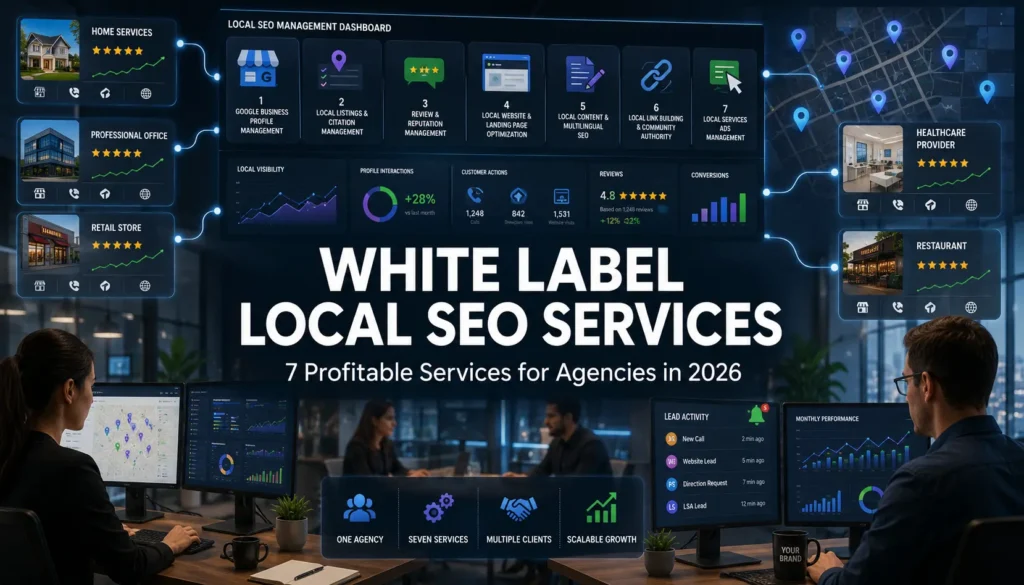
Profitability does not come from outsourcing alone. It comes from selecting repeatable services, defining ownership, controlling scope, reviewing every public change, and pricing the client account around the full delivery cost. The seven services covered below can support recurring agency revenue because each addresses an ongoing local visibility, reputation, website, or lead-management requirement.
White label local SEO services are local search marketing activities completed by a third-party fulfillment team and presented under the contracting agency’s brand. The client buys the service from the agency, communicates with the agency, receives reports from the agency, and holds the agency responsible for delivery. The provider works behind the scenes under an agreed scope, service standard, communication structure, and confidentiality arrangement.
The service model commonly covers Google Business Profile work, directory listings, local website optimization, review workflows, location content, local links, reporting, and paid local lead management. It may form part of a broader search engine optimization offer that also includes technical audits, content strategy, on-page improvements, analytics, and authority development.
White labeling differs from basic task outsourcing because the deliverables are designed for resale. Reports, dashboards, documents, and communications use the agency’s identity. The provider normally avoids direct client contact or joins calls under a defined agency-facing role. This arrangement requires more than production capacity. It requires confidentiality, predictable processes, neutral branding, revision controls, and a clear understanding of who has authority to approve changes.
The agency should never treat the provider as the final decision-maker. Local business information often involves legal names, professional licenses, service areas, opening hours, regulated claims, customer communications, and public contact details. The client supplies and confirms factual information. The agency approves the strategy. The provider implements authorized tasks and records the completed work.
Local SEO services can become profitable because many deliverables require recurring maintenance and can be standardized across similar client accounts. Business information changes, new reviews appear, competitors update their profiles, location pages require improvement, directories develop inconsistencies, and lead sources need monitoring. A structured monthly plan turns these recurring requirements into a predictable service operation.
The commercial advantage comes from productization. An agency can define a fixed onboarding process, supported business categories, monthly deliverables, approval deadlines, communication frequency, revision allowance, and reporting format. A documented offer reduces custom planning on every account and gives the fulfillment team a repeatable production sequence. Standardization also makes account management easier because the agency can explain exactly what the client receives.
Local search work also connects naturally with services already sold by web design, branding, social media, paid advertising, and general digital marketing agencies. A website client may require location pages after launch. A reputation client may need a structured review request process. A paid media client may benefit from Local Services Ads management. These connections can deepen an existing engagement without forcing the agency to build every specialist function internally.
Profitability still depends on scope discipline. Unlimited edits, unmanaged client delays, unsupported industries, urgent reinstatement work, custom reporting, and extensive content revisions can remove the margin from an otherwise viable plan. Strong offers define what is included, what requires separate approval, and what triggers an additional fee.
The most commercially useful white label local SEO services combine recurring demand, measurable deliverables, and clear production boundaries. Each service below can operate alone, yet stronger packages connect several services around one local customer journey.
Google Business Profile management covers the ongoing accuracy, completeness, presentation, and monitoring of a client’s profile. Fulfillment may include category review, business descriptions, opening hours, service details, photos, attributes, products, appointment links, questions, posts, duplicate checks, profile monitoring, and performance reporting.
A complete profile supports relevance by helping Google understand the business and match it with appropriate local queries. Google explains that local results are mainly shaped by relevance, distance, and popularity, with prominence also influenced by links, reviews, and general recognition. No agency or provider can purchase a stronger organic local position directly from Google.
The profitable version of this service focuses on managed maintenance, not a one-time profile edit. Agencies can package an initial profile audit and correction project with monthly monitoring, approved updates, photo coordination, post scheduling, review oversight, and reporting. The provider should record the original state, proposed changes, approval status, implementation date, and final verification.
Ownership creates a major control point. Google states that end customers must retain ownership or co-ownership of their Business Profile. Agencies managing an existing profile should normally receive manager access instead of taking ownership. Public edits and review responses also require appropriate client authorization.
A responsible offer avoids category manipulation, fake locations, keyword-stuffed business names, virtual-office abuse, unauthorized address changes, and unrealistic ranking promises. The agency remains responsible for confirming that each location represents an eligible business and that published information matches the client’s actual operations.
Local listings management controls how a business’s core information appears across directories, maps, industry platforms, data aggregators, and customer-facing applications. The service begins with a verified source record containing the approved business name, address, phone number, website, opening hours, category, service area, and location-specific details.
The fulfillment provider audits existing mentions, identifies duplicates, corrects material inconsistencies, submits accurate information to relevant platforms, and monitors future changes. This work is especially valuable for companies with multiple locations, previous phone numbers, relocated offices, franchise structures, practitioner listings, or inconsistent naming conventions.
A profitable package separates foundational cleanup from ongoing monitoring. The initial project may require manual research and platform-specific correction requests. Monthly service can focus on detecting material changes, handling approved updates, managing duplicates, recording unresolved listings, and maintaining a clean location data file.
Agencies should avoid selling citation volume as the main outcome. Hundreds of low-quality submissions can create noise without supporting customer access or business credibility. Platform relevance, data accuracy, duplicate control, and durable ownership carry more practical value than a large submission count.
The client must remain the factual authority. The provider should never guess operating hours, service areas, professional titles, business categories, or location details. Every submission should reference the approved source record, and every unresolved discrepancy should appear in the client report.
Review and reputation management creates a documented process for requesting genuine customer feedback, monitoring new reviews, drafting responses, escalating sensitive complaints, and reporting recurring service themes. The offer may cover Google Business Profile, relevant industry platforms, and other channels that influence local customer decisions.
The service becomes commercially sustainable through workflow management. A provider can prepare compliant request templates, generate review links, organize response queues, draft brand-aligned replies, categorize feedback, and identify reviews that require client input. The agency approves the strategy and response standards. The client confirms facts related to complaints, refunds, safety issues, legal disputes, or regulated services.
Review generation requires strict boundaries. Google prohibits fake engagement and content that does not represent a genuine experience. The Federal Trade Commission also prohibits the creation, purchase, or sale of fake reviews, incentives conditioned on positive or negative sentiment, certain undisclosed insider reviews, and specific forms of review suppression.
A safe process asks real customers for honest feedback without dictating the rating or sentiment. Requests should not offer a reward only for a positive review. Staff, owners, relatives, contractors, and agency personnel must not post undisclosed reviews that create a misleading impression of independent customer experience.
Response authority should also be documented. Routine positive reviews may use preapproved response patterns with human personalization. Complaints involving injury, discrimination, legal allegations, privacy, employee conduct, billing disputes, or professional advice should move to the client’s designated decision-maker before publication.
Local website optimization aligns the client’s owned website with its actual services, locations, customer needs, and conversion paths. The service can cover location architecture, service-area pages, title elements, headings, internal links, contact information, embedded maps, structured data, mobile usability, calls to action, conversion tracking, and technical indexation checks.
This service often exposes the difference between a visible profile and a credible local business presence. A profile may attract attention, yet the linked website still needs accurate service details, clear location information, useful content, trustworthy proof, and a direct path to contact. Weak pages with only a city name changed across multiple URLs provide little practical value and can create duplication.
The provider should begin with page purpose and business reality. One physical location serving several nearby areas may require a different structure from a franchise network with separate offices. Location pages should reflect genuine differences in services, staff, facilities, coverage, processes, customer questions, and local operating details.
Implementation may involve the client’s developer or a website development team. The SEO provider defines requirements, reviews the proposed changes, and verifies the completed work. The developer controls deployment, backups, templates, security, staging, and production releases.
A profitable offer separates strategic recommendations from development hours. Page planning, copy optimization, technical review, schema recommendations, and quality checks can sit inside the local SEO scope. Custom design, template development, complex tracking, form integrations, and extensive coding should carry separate estimates.
Local content production creates useful pages and articles connected with the client’s services, locations, customer questions, seasonal demand, and community context. Common deliverables include service-area pages, location pages, local resource pages, project summaries, event-related content, customer guidance, and updates tied to operational changes.
The strongest local content serves a real business purpose beyond inserting geographic terms. A useful page explains service availability, travel boundaries, appointment requirements, pricing factors, local regulations, response times, property types, common problems, or location-specific delivery details. Accurate information strengthens the page’s value for customers and gives search systems clearer entity relationships.
Multilingual local SEO adds translation, localization, language-specific page architecture, local terminology, translated calls to action, and quality review by a fluent subject-aware editor. Literal translation alone can produce awkward service language, incorrect legal terminology, weak geographic references, and inaccurate customer expectations.
This service requires a controlled editorial process. The client provides factual information and approves regulated claims. The provider prepares the brief, draft, on-page elements, internal linking recommendations, and publication notes. A qualified reviewer checks language quality, factual accuracy, tone, formatting, and duplication before release.
Agencies can protect margin through defined monthly production units. One unit may represent a location page, a substantial article, or an existing-page update. Word count should not become the sole pricing measure. Research depth, interviews, approvals, formatting, original media, revisions, and multilingual review all influence production cost.
Local link building develops relevant references from organizations, publications, associations, suppliers, partners, directories, sponsorships, and community resources connected with the client’s real operations. The goal is to strengthen online authority through legitimate relationships and useful local information, not mass placement.
A provider may research local chambers, trade groups, professional memberships, event websites, community organizations, supplier directories, scholarship pages, local media, neighborhood resources, and existing unlinked mentions. Outreach should present a credible reason for inclusion. Membership, sponsorship, partnership, expertise, data, events, or genuinely useful resources can support that reason.
The service becomes easier to manage through an opportunity pipeline. Each prospect should record relevance, contact source, outreach status, commercial terms, required client action, link destination, publication result, and quality review. The agency can then report completed work without presenting every email as a secured outcome.
Paid placements require transparency and careful evaluation. A fee does not automatically make a reference valuable, and a free listing does not automatically make it safe. The provider should avoid private blog networks, automated guest posts, irrelevant international directories, copied articles, hidden links, and guarantees based on a fixed number of placements.
The client often controls the strongest opportunities. Existing suppliers, associations, sponsorships, community projects, professional memberships, and local partnerships can produce credible references once properly documented. The agency should include client contribution requirements during onboarding instead of treating link acquisition as a provider-only task.
Local Services Ads management can complement organic local SEO for eligible service businesses by controlling setup, budget, service categories, bidding, lead handling, reporting, and account monitoring. It should be sold as a separate paid lead-management service because advertising spend, eligibility, verification, billing, and lead operations differ from organic optimization.
Google states that advertisers pay for valid leads and set an average weekly budget. Weekly spending can exceed that average, yet the account remains subject to a calculated monthly maximum. Lead cost can vary by location, service type, lead type, and bidding mode. Campaign edits and pausing take place through the Local Services Ads interface, with billing connected to Google Ads.
The fulfillment scope may include profile setup, service selection, geographic coverage, budget monitoring, lead categorization, call and message review, lead feedback, booking tracking, and monthly analysis. Lead quality reporting should distinguish platform charges, valid contacts, booked opportunities, completed jobs, and client-side response problems.
Reviews also influence Local Services Ads performance. Google states that star ratings and review volume affect ad ranking, and reviews are managed through Google Business Profile Manager. This connection makes reputation management and paid local lead generation commercially compatible services.
Agencies can connect this offer with broader PPC management, yet the reporting should remain separate from standard paid search campaigns. Local Services Ads use a lead-based operating model, distinct interfaces, eligibility rules, and service-specific controls.
Profitability depends heavily on lead follow-up. A technically sound campaign still underperforms commercially when calls go unanswered, messages receive late replies, booking data remains unavailable, or staff cannot handle the lead volume. The client must own sales response, appointment handling, service quality, and revenue tracking.
The white label local SEO model involves three operational parties: the client, the agency, and the fulfillment provider. The client supplies business facts, owns core accounts and assets, approves public information, and handles service delivery to customers. The agency controls strategy, pricing, communication, priorities, approvals, reporting, and the commercial relationship. The provider completes assigned production tasks and documents the work.
A stable workflow moves information through the agency instead of creating an uncontrolled direct channel between client and provider. The agency collects the brief, confirms missing facts, approves the provider’s recommendations, and presents the final output. Direct provider participation can still work during technical calls, yet roles and branding should be agreed before the meeting.
Deliverables should move through an approval sequence. The provider submits the recommendation and supporting evidence. The agency reviews strategic fit and presentation. The client approves factual or public-facing changes. The provider implements the authorized work. The agency verifies completion and explains the outcome in the client report.
Communication standards should define turnaround periods, revision limits, urgent issue categories, escalation contacts, meeting frequency, file locations, and reporting dates. A provider with strong technical skills can still create client risk through inconsistent communication, missing documentation, or unclear responsibility.
The agency remains accountable even when the provider makes the error. Client contracts should describe third-party fulfillment appropriately, protect confidential information, define service boundaries, and avoid claims that exceed the agency’s operational control.
A controlled launch process reduces ownership disputes, inaccurate public information, duplicated work, and margin loss. The following sequence turns a general outsourcing relationship into a governed agency service.
Start by defining the client problem, supported business types, included services, excluded work, billing structure, communication frequency, reporting schedule, and revision policy. A broad promise to “handle local SEO” creates conflicting expectations because the phrase can cover profiles, websites, reviews, content, links, advertising, analytics, and technical support.
The expected output is a written service specification. It should describe onboarding deliverables, monthly tasks, client responsibilities, provider responsibilities, agency responsibilities, approval deadlines, and additional-fee triggers.
Create an ownership register before requesting access. Record the owner of each Business Profile, website, domain, analytics property, advertising account, call-tracking number, reporting dashboard, directory login, content file, and creative asset.
The client should retain ownership of core business assets. The agency and provider receive role-based access required for assigned work. This structure supports continuity after staff changes, provider changes, or contract termination.
The expected output is a signed access and ownership record with named administrators, recovery contacts, and offboarding actions.
Use a structured onboarding form to collect legal business details, public trading names, addresses, service areas, opening hours, primary phone numbers, websites, categories, services, licenses, appointment links, brand guidance, target locations, and approval contacts.
Credentials should move through an approved password management system. Shared spreadsheets, email threads, and informal messages create avoidable security and continuity problems.
The expected output is a verified business information record and complete access checklist.
The provider reviews the client’s profiles, listings, website, location pages, review patterns, local competitors, technical issues, authority signals, conversion paths, and tracking setup. The audit should distinguish factual errors, policy concerns, technical defects, content gaps, and optional opportunities.
The agency reviews the audit before it reaches the client. Recommendations should reflect actual business priorities and avoid overwhelming the client with low-impact tasks.
The expected output is a prioritized audit supported by URLs, screenshots, account data, and clear explanations.
Convert the audit into a phased plan based on urgency, business impact, effort, access requirements, and approval needs. Ownership problems, incorrect contact details, suspended profiles, indexation failures, and broken lead paths normally require attention before ongoing content production.
Each action should identify the responsible party, required input, approval owner, target completion period, verification method, and reporting category.
The expected output is an operational roadmap that both the agency and provider can execute.
Public information should receive approval before implementation. The approval process applies to business names, addresses, categories, service areas, opening hours, review responses, location copy, regulated claims, prices, staff information, and customer-facing offers.
The client confirms facts. The agency confirms strategic and brand alignment. The provider implements only the approved version and records the approval source.
The expected output is a traceable approval history connected with each material change.
Production should begin through scheduled work queues, not scattered requests. The provider completes assigned tasks, stores evidence, records blockers, and submits deliverables for review. The agency monitors deadlines, client dependencies, and scope consumption.
Urgent requests require a separate definition. A true emergency may include profile suspension, incorrect public contact information, a broken booking path, or a major tracking failure. Routine client preferences should remain inside the normal production queue.
The expected output is consistent delivery supported by task records and implementation evidence.
Monthly reporting should connect completed work with meaningful business signals. Useful reporting may include profile interactions, calls, direction requests, website conversions, booked leads, review activity, local landing-page engagement, listing corrections, completed tasks, unresolved risks, and next priorities.
Rank tracking can provide context, yet it should not act as the only measure. Local visibility changes by location, device, distance, personalization, and query. Reports should explain what changed, what the team completed, what remains uncertain, and what the client must address.
The expected output is an agency-branded report with strategic commentary, not a raw dashboard export.
Scale begins after the workflow performs reliably on a controlled client group. Document onboarding, audits, approvals, content standards, profile work, review responses, reporting, access management, and offboarding before adding a large number of accounts.
Capacity planning should use production hours and complexity categories. A single-location retailer, a service-area business, a professional practice, and a multi-location franchise create different workloads.
The expected output is a repeatable operating system that preserves quality as account volume grows.
The client owns the business identity, factual information, customer relationships, website, domain, profiles, analytics data, advertising accounts, phone numbers, and approved content. Client representatives confirm operating details, approve public claims, handle sensitive complaints, process leads, and communicate internal changes that affect published information.
The agency owns the commercial strategy, service packaging, client contract, pricing, account management process, reporting interpretation, and final delivery standard. It coordinates approvals, translates business goals into production priorities, checks provider work, and resolves communication gaps.
The provider owns its internal methods, staffing, task execution, production documentation, and quality process. It does not own the client’s profiles, data, content, or advertising accounts. Provider-created files should be transferred to an agency-controlled repository throughout the engagement.
Access should follow the minimum-permission principle. Team members receive only the permissions needed for assigned tasks. Multi-factor authentication, password management, named user access, recovery procedures, and periodic access reviews reduce the risk created by shared credentials.
Offboarding should form part of onboarding documentation. The process should remove provider access, transfer editable files, return client data, document unfinished work, export reports, confirm account ownership, and identify subscriptions that require cancellation or reassignment.
Quality assurance should review strategy, facts, technical implementation, editorial quality, brand alignment, policy compliance, and final verification. One general proofreading step cannot cover every risk involved in public profiles, websites, reviews, listings, advertising, and customer data.
Strategic review confirms that each task supports the client’s business model, priority services, operating locations, and commercial goals. Factual review checks names, addresses, phone numbers, hours, service areas, licenses, staff details, offers, and claims against approved source information.
Technical review checks indexation, redirects, canonical elements, internal links, structured data, mobile behavior, tracking, forms, page performance, and deployment accuracy. Editorial review examines clarity, duplication, local usefulness, grammar, tone, unsupported claims, and customer relevance.
Brand review checks terminology, voice, visual presentation, response style, and client-specific requirements. Policy review checks profile eligibility, review practices, advertising rules, ownership controls, disclosures, and platform restrictions. Final verification confirms that the approved change appears correctly on the live platform.
Every material action should retain an evidence trail containing:
Errors require a defined response: acknowledge the issue, contain its impact, correct the work, document the cause, and update the process. Hiding a mistake increases the commercial and reputational risk. A transparent correction process protects the client relationship and strengthens future delivery.
Operational risks arise after work begins. Common risks include unauthorized public edits, inaccurate business information, weak content, delayed approvals, missed review responses, duplicate profiles, broken tracking, poor lead handling, uncontrolled access, low margins, provider staff turnover, and incomplete documentation.
Vendor concentration creates another risk. An agency that relies on one provider for every profile, page, report, listing, and login may struggle during a service interruption. Agency-controlled documentation and asset storage reduce this exposure.
Scope creep often begins through small requests. Extra locations, additional platforms, custom reports, emergency calls, repeated copy revisions, development work, and client training can accumulate without a corresponding fee. The service agreement should define included quantities, revision limits, response periods, and change-order procedures.
Provider red flags appear during evaluation. Warning signs include guaranteed rankings, ownership demands, password sharing, hidden subcontracting, copied samples, vague reporting, no revision policy, no escalation route, no offboarding process, mass-produced location pages, automated review schemes, guaranteed link quantities, and reluctance to explain production methods.
Request evidence before assigning a full client portfolio. Useful evidence includes anonymized work samples, workflow documents, reporting examples, quality checklists, access procedures, communication standards, staffing information, policy guidance, revision records, and a written pilot scope.
A paid pilot provides stronger evidence than a sales presentation. The pilot should test one controlled client account or a defined project with clear acceptance criteria. The agency can evaluate communication, accuracy, documentation, strategic judgment, turnaround, revision handling, and brand neutrality before expanding the relationship.
A web development agency serves home-service companies and regularly receives requests for Google Business Profile management, review support, location pages, and local lead reporting. The agency has developers and designers but no dedicated local SEO production team.
The agency creates a monthly local visibility package containing profile management, listings monitoring, review workflow support, two page updates, monthly reporting, and quarterly strategy reviews. A fulfillment provider completes audits, drafts recommendations, prepares content, monitors listings, and creates reporting files. The agency retains control of strategy, client communication, approvals, and invoicing.
The client owns its Business Profile, website, analytics properties, advertising accounts, and phone numbers. The agency receives manager or administrative access. The provider receives limited access for approved production work. All parties use an agency-controlled project system and file repository.
During onboarding, the provider identifies inconsistent opening hours, an old phone number on several directories, thin service-area pages, and missing call-conversion tracking. The client confirms the correct details. The agency approves the action plan. The provider completes the authorized changes and records implementation evidence.
The practical limitation appears in lead handling. Several calls arrive outside the client’s staffed hours. Local SEO cannot correct an internal response gap alone. The agency reports the problem, and the client changes its call-routing process.
This scenario demonstrates that white label fulfillment expands delivery capacity, yet the agency and client still control the decisions that influence commercial outcomes.
Scaling local SEO requires standardization before volume. The agency should define supported services, client categories, location limits, production units, approval standards, reporting definitions, access requirements, revision allowances, and escalation procedures.
Client segmentation improves capacity planning. A basic single-location account may require profile maintenance, review monitoring, citation checks, and reporting. A multi-location organization may require location data governance, duplicate management, content coordination, permission controls, and consolidated reporting. Charging both accounts through the same scope creates margin and delivery problems.
A shared operations dashboard should track onboarding status, missing access, client approvals, production tasks, quality checks, reporting deadlines, risks, and expansion opportunities. The provider can update task completion, but the agency should own the system and maintain visibility across every account.
Standard operating procedures should cover recurring actions, yet professional judgment remains necessary. A template can guide a review response, page brief, listing correction, or monthly report. It cannot confirm a disputed customer event, determine business eligibility, approve a regulated claim, or decide the correct account owner.
Provider performance should receive quarterly evaluation based on accuracy, turnaround, revision rates, communication, documentation, policy compliance, client-impacting errors, and process improvement. A low fulfillment price carries limited value when agency staff spend extensive time correcting the work.
Long-term scale comes from a controlled relationship between sales promises and production capacity. Sales teams should not offer unsupported deliverables, immediate ranking outcomes, unlimited revisions, or custom work outside the documented service model. Operational leadership needs authority to approve exceptions and price them correctly.
White label local SEO services can create a profitable agency offer when delivery remains standardized, governed, and connected with genuine client needs. The strongest services produce recurring work through profile maintenance, listing accuracy, reputation workflows, website improvement, local content, authority development, and lead management.
The agency remains the accountable party throughout the relationship. It must control scope, protect account ownership, confirm client facts, review provider work, explain performance, manage approvals, and price the service around its full operational cost. Outsourcing production does not outsource commercial responsibility.
Start with a narrow service package, document every role, test the provider through a paid pilot, and expand only after quality and margin remain stable. That approach turns white label local SEO from an informal subcontracting arrangement into a scalable agency delivery system.
Markwhiz delivers innovative digital marketing, branding, and web solutions that help businesses grow online with strategy, performance, and measurable results.